What is Industrial Chemical - The Use of Industrial Chemicals, Types of industrial chemicals
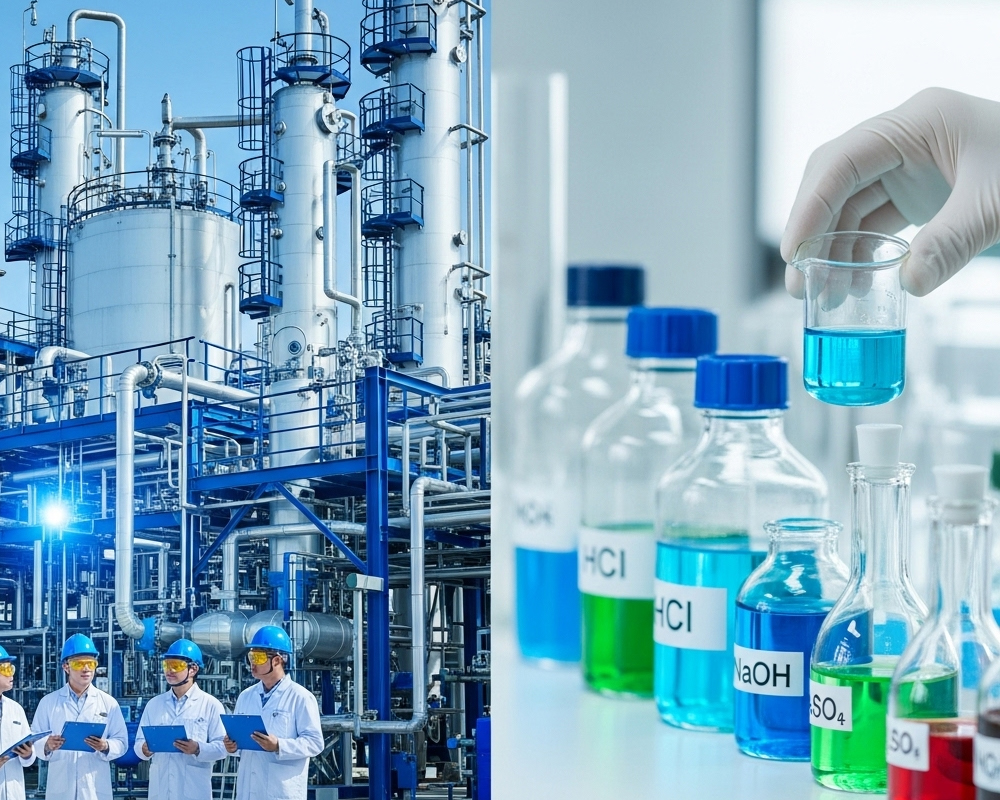
Regardless of its form, i.e. books, drugs, electronic devices, cosmetics, fuel, food, etc., no single object we see in our everyday life can be deprived of industrial chemicals. Industries across the globe cannot function without chemicals, which are mass-produced. Chemicals are indispensable to industries worldwide, and these are mass-produced. They transform undifferentiated materials into commodities that individuals can consume. These chemicals promote mass production and innovation that have characterized modern living. From agricultural yields to production of advanced technology; industrial chemicals are essential in the production of modern demands and the sustenance of modern lifestyles.
What are industrial chemicals?
Industrial chemicals are chemicals that are produced or extracted in large or bulk quantities to be applied in industries. Industrial chemicals are not designed with small-scale and daily needs in mind in comparison with household chemicals. They can be natural (natural materials, e.g., minerals, petroleum, plants) or synthetic (created in the laboratory in the form of chemical combinations) and solid, liquid, or gaseous. The chemicals can be any type, but they form the basis of the modern industry, which is possible due to innovations and mass production.
Applications:
- Agriculture: The fertilizers, such as urea and phosphates, make the soil fertile, and the pesticides and herbicides destroy crops disturbed by crop-eating pests and weeds. These are the chemicals that will ensure the world has better harvests and, as a consequence, food security.
- Pharmaceuticals & Healthcare: Medicines, medical equipment, and vaccines are also produced using chemicals. They are also employed in disinfectants, antiseptics and preservatives, to affect hygiene and, quite simply, to make the product last longer.
- Foods & Drinks: The preservatives, stabilizers, added flavourings, and all other food-grade chemicals contribute to the safety of the food, its freshness, and taste. They are also applied in wrapping the substances and packaging materials with the ability to resist food during storage and transportation.
- Foods & Drinks :The preservatives, stabilizers, added flavourings, and all other food-grade chemicals contribute to the safety of the food, its freshness, and taste. They are also applied in wrapping the substances and packaging materials with the ability to resist food during storage and transportation.
- Energy & Fuels :The end products of petrochemicals are the fuels such as gasoline, diesel, kerosene, hydrogen, and oxygen gases used in energy systems that produce renewable and industrial activities.
- Water Treatment :The chemicals introduced to clean both drinking water and wastewater are chlorine and alum, which make pure and clean water available.
- Electronics and Technology :Chemicals with high purity allow manufacturing of semiconductors, batteries, and solar panels that are important in modern technology and clean energy.
- Textiles & Leather :To enhance the quality and appearance of textiles, dyes, bleaching reagents, and finishing reagents are used, and tanning reagents are required in the production of raw skins to a light leather.
- Manufacturing & Construction :Plastics, rubbers, paints, adhesives, and coatings are some of the products that can be made using industrial chemicals. They are used in cement as an additional component, protects waterproofing, a protective covering, which makes the structure more solid and durable.
Types of Industrial Chemicals
Industrial chemicals are categorised based on their composition, purpose, and industrial uses. Information about such types assist industries in knowing the right kind of chemical to apply in a given process.
- Basic (commodity) Chemicals :These are built in enormous quantities and are constructed into other goods. Examples include sulfuric acid, sodium hydroxide, and ammonia. They are highly prevalent in plastics, fertilizers, and detergents.
- Specialty Chemicals :These highly valuable chemicals are created in small quantities to undertake a specific activity. Examples include adhesives, sealants, corrosion inhibitors, surfactants, electronics, coatings, and the automotive industry.
- Agrochemicals :Chemicals (fertilizers, pesticides, herbicides, fungicides) increase production and safeguard crops against insects and diseases.
- Petrochemicals :Petrochemicals such as ethylene and propylene, benzene and toluene are also products of natural gas and petroleum, and the use of these products is in plastics, synthetic fibers, and resins.
- Polymers & Plastics :Chain-extended by polymerization -polyethylene, polypropylene, PVC, and polystyrene. They find application in packaging, building products, electronics, and consumer products.
- Inorganic Chemicals :Non-carbon substances including acids, alkalis, salts, oxides (oxide of titanium). It is consumed in pigments, fertilizers, water treatment, and detergents.
- Organic Chemicals :Hydrocarbons and carbon compounds consisting of alcohols, ketones, aldehydes, and phenols. They are used as solvents, as resins and intermediate coatings, and as adhesives.
- Industrial Gases :Other gases produced and distributed in large quantities are oxygen, nitrogen, hydrogen, and carbon dioxide that are used in welding, refrigation, and food processing.
- Pharmaceuticals & Biochemicals :Specialty chemicals find application in the manufacture of drugs, researches, and medical equipment. For example, active pharmaceutical ingredients (APIs), reagents, and solvents.
Conclusion
Industrial chemicals are the hidden drivers in modern times, which run industry, innovation, and a variety of conveniences. These chemicals are used in agriculture and healthcare, construction, and technological industries, as well as food production, to convert raw materials into usable goods and products and increase their quality and enable mass production. The analysis of their varieties and uses shows that they are very crucial in economic growth and the development of societies.